
The Architecture of Earth & Sky


The Earth & Sky practice is, fundamentally, a search for the whole body mechanism and a method to gain conscious control over it. Within the broader architecture of our curriculum, this exercise lives precisely in the transition from the Discover phase to the Develop phase of the Discover, Develop, Apply (DDA) cycle. We are taking the raw, integrated feeling states we have discovered in stillness and beginning to consciously control them through dynamic, structural pathways.
Before initiating the physical movement of connecting the earth to the sky and the sky back to the earth, we must pull our awareness into the Nowspace and establish our Natural Stance. However, at this stage in your training, you should be able to activate your frame entirely by recall. Having previously gone through the foundational routes—whether the ECP Initiation, the Swimming Through Space program, or both—the meticulous, step-by-step procedures of gravity stacking, rooting and branching, and opening and closing are now reduced to a single, memory-banked feeling state. You bypass the intellectual checklist, recall the sensation of whole-body tensegrity, and instantly snap the frame online.
Operating from this precise feeling state is absolutely essential. If you attempt the physical movements of Earth & Sky but inadvertently trigger your habitual, localized, and direct use of muscular force, you are actually working backward in the process. The conventional, lever-based paradigm of isolating muscle groups creates rigid walls of tension that break the kinetic chain and dampen your physical sensitivity. Instead, we are seeking the simultaneous articulation of all the joints during the exercise, ensuring that no single muscle chain ever operates in isolation.
Achieving this simultaneous articulation requires us to synchronize the body's activated arches. We intentionally link the opening and closing of the arches in the legs and hips (the kua) with the corresponding structures in the arms and shoulders. When these upper and lower components are yoked together, the entire body functions like a giant internal trampoline. It stores and releases kinetic force within the absolute oneness of the frame, utilizing the elastic rebound of the connective tissue to generate movement without relying on muscular grinding or sheer willpower.
To truly find this integrated connection, we must utilize the tool of exaggeration. Exaggerating the movement not only helps induce every single joint to articulate, but it forces you out of your "intellectual box". When you feel slightly ridiculous in how dramatic and large you are performing the exercise, you know you are successfully stepping outside of your comfort zone and breaking free from your habitual, localized movement patterns. Moreover, making the movement ridiculously large makes the gross patterns and internal routes of strength far more obvious to the nervous system. By laying the pattern in heavily on the outside, it becomes much easier to internalize; the massive feeling state cultivated by the exaggeration is simply brought within the frame when the physical expression is eventually shrunk back down.
The Engine of Movement: The Expand and Contract Cycle in Earth & Sky
The kinetic engine driving the Earth & Sky exercise is a continuous, alternating cycle of expansion and contraction. The physical movement begins with a profound emphasis on expansion in all directions—reaching up, stretching out, and extending down from the fingertips to the toes. You are intentionally establishing a vertical connection between the earth and the sky, pressing outward to create six surfaces of strength. This massive, omnidirectional expansion must be firmly established in the body before the contraction phase is ever initiated.
The secret to this engine—and the reason the exercise can feel highly counterintuitive at first—is the principle of overlapping or "folding" strength. Folding strength is the ability to transition from one movement to another without ever breaking the structural unity of the frame. To achieve this, the practitioner must deliberately reset and re-establish the integrated state at the beginning of each gesture. In the beginning stages, you must be incredibly pedantic with this procedure. This momentary reset is actually far more important than the gross physical gesture itself, as we are beginning the precise process of conditioning the nervous system to interface with the environment through the feeling of the whole rather than through isolated parts. If you skip this crucial reset step in a rush to perform the movement, you will inevitably regress to using localized, direct muscular force rather than cultivating unified elastic power, or Hunyuan Li.

Once this expanded state is firmly reset, the contraction begins, but it does not replace the expansion. Instead, the whole body contracts directly against that feeling of expansion, much like loading a physical spring. You pull yourself downward by squeezing that expansive feeling together, never dropping the underlying expansion even as the contracted feeling begins to dominate. Maintaining this constant, mutual interpolation between expanding and contracting ensures that the body operates as a fully integrated, pressurized vessel. As your training evolves through the Discover, Develop, Apply (DDA) cycle, the pedantic step of resetting will automatically fold into the gesture itself, occurring instantaneously without needing to be treated as a separate beat.
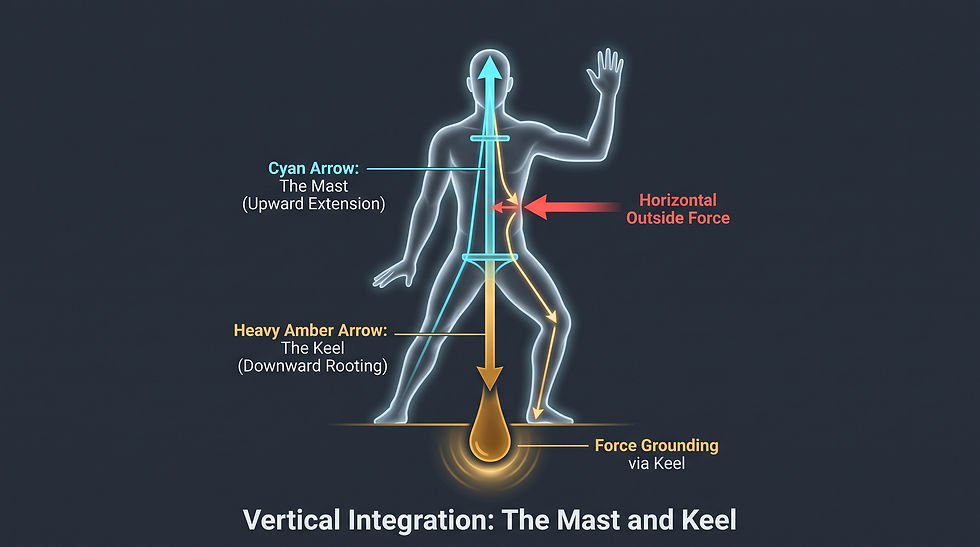
Earth & Sky is purposefully focused on the vertical field of movement. By uniting "up" and "down," you are mimicking the biomechanical strategy of a tree, where the heavy, sinking surrender of the roots and the buoyant, spring-loaded suspension of the branches mutually rely on one another as a yin and yang pairing. This deep vertical alignment functions much like a ship's mast and its deep-water keel. Ultimately, this vertical integration is the true source of strength in the horizontal plane. Drawing on wisdom found in arts like Aikido (harmonizing and blending with incoming energy) and Liu He Ba Fa (the unbroken, multi-directional continuity of water), this deep vertical alignment is what eventually allows the practitioner to take horizontal outside force and seamlessly direct it into the mutual flow of gravity and the Ground Reaction Force (GRF) that is alive within their frame.
Decoding Weight Transitions: Parallel vs. Front-Back Stances
The Earth & Sky mechanics are initially learned in a parallel stance, typically utilizing a low, open arm carriage like Position #8. In this parallel orientation, the practitioner executes the expand-contract cycle while continuously shifting weight back and forth between the left and right legs. However, because the feet remain stationary and the body does not visibly travel, this internal weight transition is largely hidden from the outside observer. While concealing internal mechanisms is a hallmark of advanced martial practice, it makes the baseline mechanics incredibly difficult to learn; without visual feedback, practitioners often mistakenly remain double-weighted or allow the exercise to be entirely dominated by the swinging of the arms, neglecting the lower body engine entirely.

To solve this lack of clarity, the practice intentionally shifts the movement into a front-back orientation, often referred to as a Tame the Tiger stance. By staggering the feet, the front-to-back weight transfer becomes explicit, undeniable, and much easier for the nervous system to track. In this asymmetrical stance, the expand-contract cycle naturally dictates the movement of the feet. During the profound expansion phase, the unweighted foot (such as the back foot when weight is forward) becomes one hundred percent empty, even if it remains in light contact with the floor.
As the body contracts against the expansion and pulls down into the supporting leg, this unweighted foot is completely free to slide forward, creating a built-in half step that naturally carries the stance along the floor. The same mechanical truth applies in reverse: expanding upward unweights the front foot, allowing it to slide back effortlessly as the weight sinks into the rear leg. By explicitly mapping these weight transitions and half-steps in the front-back stance, the practitioner trains the lower body to generate the force that drives the upper body's movement. Once this dynamic pattern is hardwired into the nervous system, it can be safely internalized and hidden back within the refined, parallel version of the exercise without losing its structural integrity.

The half-step we are developing here runs entirely counter to the habitual movement patterns people rely on in their "normal" stepping. In general, typical human locomotion is essentially a process of controlled falling and pushing. Most people push their body weight away from the ground, swing the unweighted foot forward, and then let their body mass fall onto the extended foot before repeating the cycle. In this standard model, the walker is actually fighting the flow of gravity to locomote. Our internal half-step works differently—even oppositely. Because the frame is already expanded, the contractive force is used to sink into the weighted leg, which mechanically floats the unweighted foot because the two legs are inextricably yoked together through the kua (the hips/pelvis). Allowing the weight to sink downward eccentrically loads the legs and hips with a springy, elastic force that then propels the walker forward. Rather than the muscles directly propelling the mass of the body through space, they simply support the internal trampoline at storing and releasing force, functioning much like a gravity sail.
A significant challenge for the practitioner is getting underneath these deeply ingrained, localized movement habits. Most folks instinctively brace or become "double weighted" in their stances, trapping their weight statically between their feet and relying on local muscle chains in their upper body to perform tasks and gestures. The immense power and strength of the lower body are present, but they remain completely unlinked from the upper body.

The trick is to use tools like this Earth & Sky exercise to forge that missing connection, linking the lower body through the back and torso directly into the upper extremities. A simplistic way to view this integrated state is as a "two kua" structure, where the vertical kua (the hips and legs) is intrinsically linked to the horizontal kua (the shoulders and arms). When these structures are successfully yoked together by the expand-contract cycle, they act in perfect unison to absorb, redirect, transfer, store, and release force throughout the entire frame.
Lower Body Integration: Opening the Kua
A common pitfall when integrating the lower body is treating the weight shift like a standard gym squat. In the Earth & Sky exercise, the legs do not simply bend and straighten to lower and raise the torso. Instead, the movement must originate from opening the kua—the natural arch and inguinal fold between the hips and legs. As your body contracts against its expanded frame, you actively pull yourself down into the stance, allowing the knees to perform a subtle, outward circular motion. This circular tracking opens the kua, storing a massive load of elastic strength that ultimately drives the structure forward or upward.
Want to read more?
Subscribe to thewayofintent.com to keep reading this exclusive post.